Questions About What Happens Inside the Countertop Shop
Most homeowners never see the building where their countertop is made. The stone leaves a kitchen template and a slab rack and comes back as finished pieces, and the middle of that journey is a noisy, wet, dusty shop full of saws, routers and polishing heads. People planning custom countertop work in Temecula, CA tend to ask the same questions about what goes on in there. The answers below are written from the fabrication side, in the order the stone moves through the shop.
What does a CNC machine actually do to the stone?
A CNC router is a computer-guided cutting and shaping machine. It takes the digital template from the kitchen visit, turns it into a toolpath, and drives a spinning diamond tool along that path. The machine cuts the outline of each piece, shapes the edge profile, and drills the faucet holes. Because the drawing came from a laser on the actual cabinets, the cut follows the real walls and not an idealized rectangle.
The advantage is repeatability. A hand cut with a bridge saw and a router depends on the steadiness of one operator on one afternoon. A CNC cut follows the same path every time, and a second identical piece can be made if a corner chips. Hand work still has a place on straight cuts, test fits and finishing touches, and many shops use both on the same job.
When is a waterjet used instead?
A waterjet cuts with a thin stream of high-pressure water carrying fine abrasive. It makes no heat and almost no vibration, so it suits cuts that would stress the stone: tight inside corners, narrow cutouts, curved shapes and delicate material. A sharp inside corner on a cooktop opening is a good example. A saw blade is round and cannot reach into a square corner, so a corner cut with a blade needs a drilled relief hole. A waterjet can follow a tighter radius and leaves a clean edge.
Waterjets also help with thin porcelain and with stones that have natural fissures, because the lack of pressure from a blade lowers the risk of cracking along a weak line. The trade is time. A waterjet cut is slower than a saw cut, so shops reserve it for the places that need it.
How is a sink cutout made?
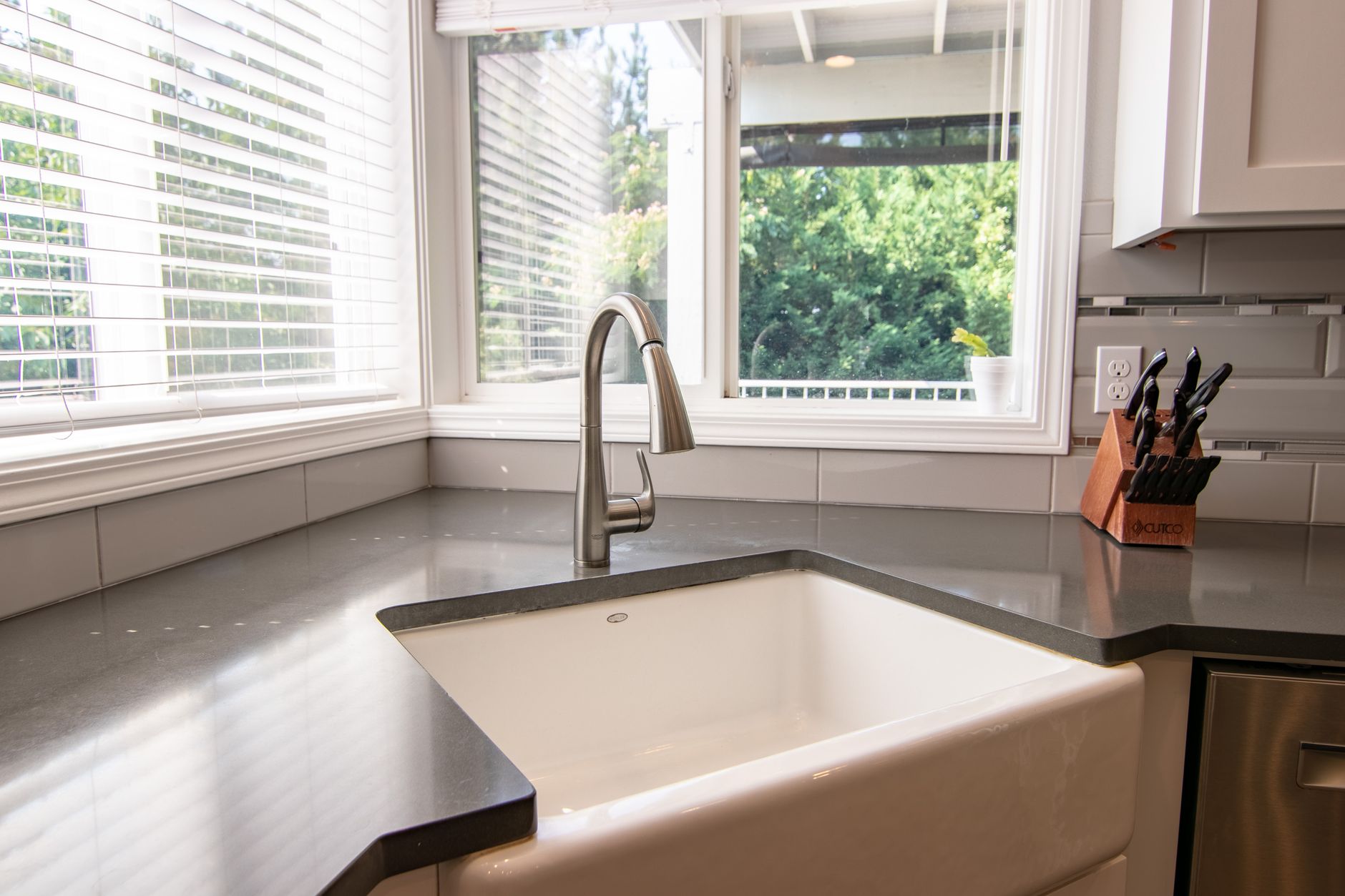
An undermount sink cutout starts with the sink itself or its exact spec sheet. The template records the sink position, and the shop cuts the opening so the rim of the bowl sits slightly inside the edge of the stone, leaving a small reveal. The inside edge of the opening is then polished, because it stays visible from below the counter and from the sink side.
The corners get the most attention. A sharp corner concentrates stress, and a stone top with a sharp corner in the cutout is more likely to crack at the narrow strip beside it. A small radius at each corner spreads that stress. The fabricator also checks how much stone is left between the cutout and the front edge, and may recommend leaving more if the stone is a soft or heavily veined one.
What happens during polishing?
After cutting, the edges are rough and dull. Polishing is a sequence of diamond pads, each finer than the last, that smooth the cut face and bring up the shine. On a long top, an operator may work the pads by hand with water running over the stone, or a machine may feed the piece past a polishing head. Every edge profile, from an eased edge to a bullnose, goes through this sequence, and the result should match the factory polish on the flat face.
Not every finish is a high shine. A honed top gets a softer final pad, and a leathered one is brushed to give a textured surface. The shop applies whichever finish the slab was chosen in, and the edge should match the face. A polished edge on a honed top looks odd, and a dull edge on a polished top looks unfinished.
How are mitered edges and laminated edges built?
A laminated edge is built by gluing a second strip of stone under the front of the top. The strip is cut from the same slab, clamped with epoxy, then shaped and polished as one thick piece. The joint line at the bottom is meant to be a hair thin.
A mitered edge is different. Both the top and the drop piece are cut at an angle, so they meet at a corner with the pattern wrapping around. The pieces are dry fitted first, checked against each other, and only then glued. A mitered waterfall at the end of an island is the most common example, and it needs stone cut in sequence so the vein flows over the corner.
How do the pieces get dry fitted?
Before anything leaves the shop, the crew often lays the finished pieces on a flat table or a mock cabinet frame to check the fit. Seams are matched, the vein is lined up, and the cutouts are held against the sink and the cooktop. This is the last point where a problem can be fixed cheaply, because an adjustment on a bench is a quick job, and the same adjustment in a finished kitchen is a return visit.
A shop that dry fits also catches mistakes in the template. A wall that moved after the visit, a cabinet that was shifted, or a sink spec that changed can all show up at this stage, and the fabricator can call the homeowner before the pieces are loaded onto the truck.
What is the shop doing about sealing?
Some stones are sealed at the shop and some at the install. Granite and marble are porous to different degrees, and a sealer fills the pores so spills sit on the surface a bit longer before soaking in. Quartz is engineered and generally needs no sealer. Quartzite varies, so the fabricator may test a drop of water on a sample to see how quickly it darkens. Whatever the stone, the shop should say whether sealing has been done and how often it needs repeating.
How is a heavy top moved and protected?
Finished stone is heavy and breaks more easily than it looks. A long piece with an undermount sink cutout is especially fragile, because the narrow strips beside the opening are the weak point. Shops move pieces on edge, on padded A-frames, and strap them to the truck with foam between the faces. Installers carry sink sections on the long edge and never lift them by the cutout.
In a place like Riverside County, where summer days run hot and homes stretch from the wine country hills down toward Pechanga, a load can sit on a truck bed longer than expected. Crews cover the stone and avoid resting a piece on one hot edge. Any scratch on the way out is another reason the polished face is checked again on arrival.
Which part of the process takes the longest?
Waiting for the slab and waiting for the shop queue take more time than the cutting itself. Once the template is approved, the actual cutting, shaping and polishing of a standard kitchen is a matter of days. A mitered waterfall or a heavily veined slab with a careful layout takes longer, because each piece has to be cut in order and fitted against its neighbor.
The simplest way to keep a project moving is to settle the choices that change the drawing early: the sink, the cooktop, the edge profile and the seam layout. Those decisions affect the toolpaths, and a late change means a new template.
What can a homeowner ask the shop?
A fabricator is usually happy to explain the process. Useful questions include whether the shop uses a CNC or a waterjet, how seams will be laid out, whether the pieces are dry fitted before delivery, and who handles the sealing. Shops that answer in specifics are usually shops that take care at each step.
The shop is where a flat plan becomes a fitted top, and knowing what happens there makes the install day easier to read.